Ludicrous
Card games at absurd scale: War and Blackjack with 1,000 players, simulated in seconds and played back in the browser with a scrubber, live table and charts. Python engine with a Rust and WebAssembly core.
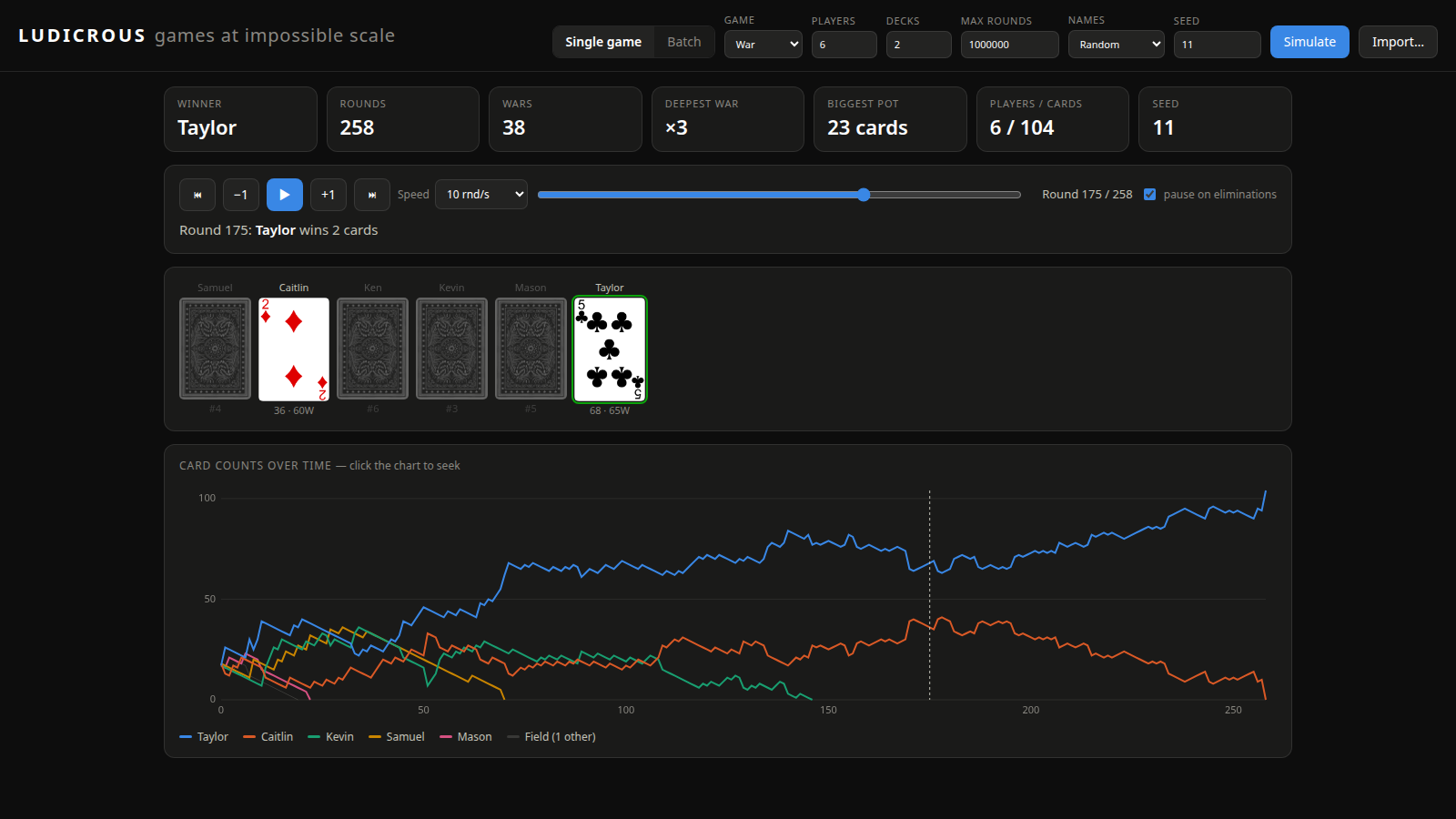
Overview
Ludicrous (formerly a Tkinter War game) takes games meant for a kitchen table and expands them far beyond what could ever be played in real life: 1,000 players, 1,000 decks, a hundred million rounds, thousands of games in parallel. A Python engine with a Rust core simulates the entire game in seconds; the browser plays it back at any speed — scrub it like a video, step round by round, or jump to the eliminations.
Highlights
- Two games — War (pure luck, up to 1,000 players) and Blackjack (multi-seat vs the dealer, S17, 3:2 blackjacks, doubling, pair splitting).
- Pluggable strategies — assign hit/stand policies per Blackjack seat and chart EV per hand by strategy over hundreds of thousands of hands; basic strategy validates at published EV.
- Video-style playback — play/pause, 1 to 5,000 rounds/sec, a scrubber, single-round stepping, and “pause on eliminations”, with real card faces and a card-count chart you can click to seek.
- Batch statistics — thousands of games in parallel across CPU cores; histograms of game lengths, wins by seat, and outlier games you can replay card by card from their seed.
- Reproducible — seeded RNG makes every game shareable as a URL; recordings export as JSON from the CLI and import in the browser.
- Rust core — batch runs and in-browser War use a Rust core compiled to WebAssembly.