Genesis
A pixel-art world that rebuilds itself from scratch every day: seeded terrain and rivers, A*-routed roads, a self-pacing 24-hour construction timeline, and a hand-rolled canvas renderer holding a 4 ms frame budget.
Overview
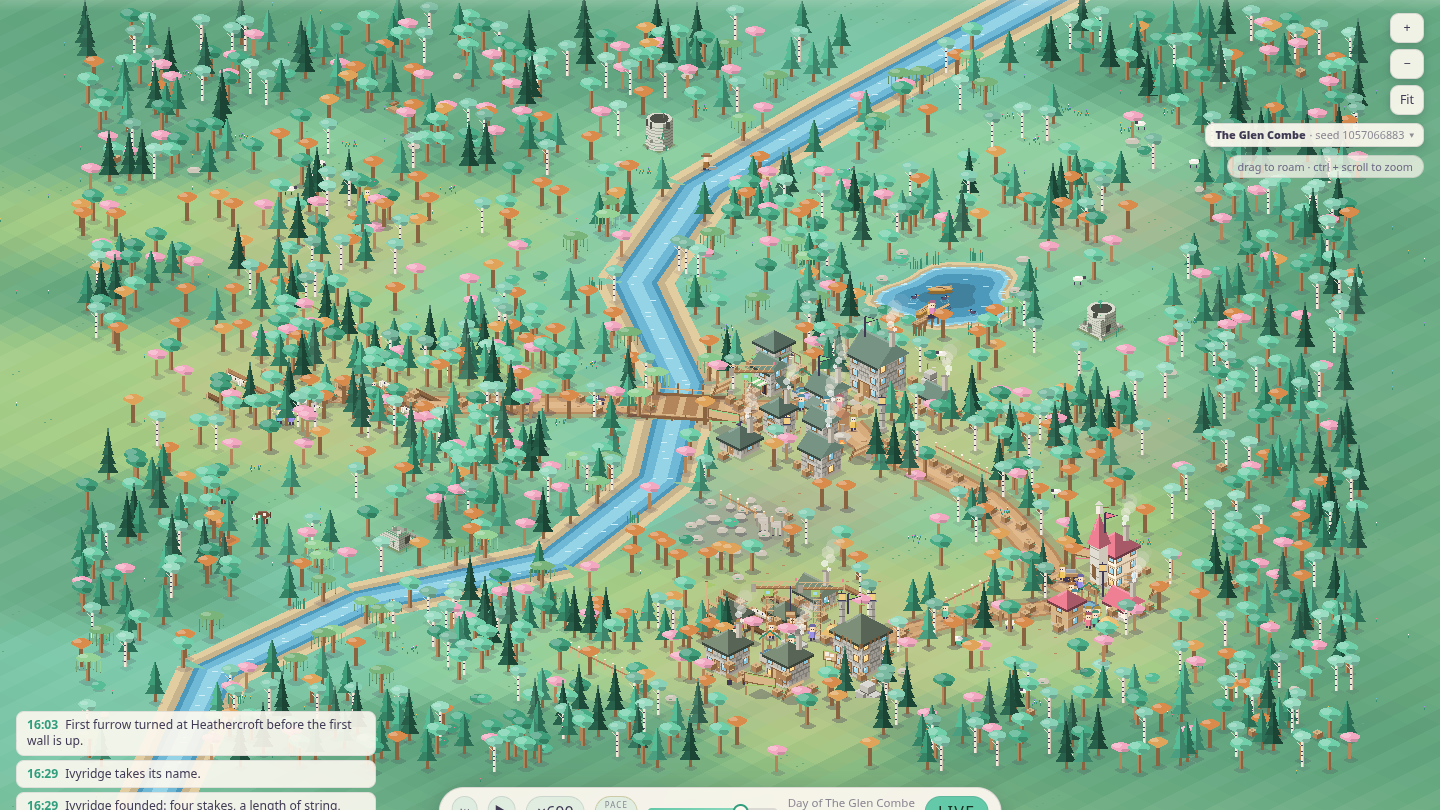
Genesis is a procedurally generated valley that lives exactly one day. It has its own page on this site. Today’s date is hashed into a seed; the seed generates the terrain, the river and lakes, the forests, the roads, and every building the day will contain; and a deterministic timeline paces that construction across twenty-four hours of the visitor’s own clock. One house at midnight, towns and a highway by evening, dark again at midnight so the next date’s valley can rise. Nothing is stored and nothing is downloaded — give the same date to any browser on earth and you get the same valley at the same hour, down to the cart on the bridge.
How it works
The valley is not stored anywhere. Today’s date is hashed into a seed, the seed generates the terrain, the river, the roads and every building the day will contain, and a timeline paces that build across twenty-four hours. Nothing is downloaded and nothing is remembered: give the same date to any browser on earth and you get the same valley, at the same hour, down to the cart on the bridge.
Because the clock is your clock, the world you land on is the world your day
has got to. Scrub it to watch the whole day in a few seconds, raise the pace
to see how much more the same twenty-four hours could have held, or stay until
midnight: the light goes, and the next date’s valley comes up in its place on
one house.
The towns are the world’s own. Their names come out of the same seed as their streets, and they are deliberately not project markers. I would rather the front door be a place than a diagram. The projects have a list of their own, where a link is a link.
Highlights
- The world is a pure function —
world = f(seed, t). Every consequence (a bridge, a gold strike, a festival) is decided from the seed by the generator and timeline; the ambient layer only performs it. Replays are identical; paused renders are pixel-deterministic. - Self-pacing timeline — a bisection search tunes the day’s tempo so the last roof lands in the final hours of the evening on any map size, from a quarter-scale hamlet pair to sixteen towns.
- Subset stability — raising the world’s pace generates the full large roster and trims it, so the same seed at a higher pace keeps identical terrain and founding towns and simply builds more.
- A living world on a frame budget — day/night, weather and rare day types (storms, eclipses, floods), wildlife, boats, prospectors and festivals, all inside a hard render budget of ~4 ms per frame, enforced by a performance harness.
- Harness-verified determinism — invariant sweeps across hundreds of seeds and a timeline suite of 60+ cases gate every change; paused-state screenshot diffing catches unintended pixel drift.
Status
Live on its own page. The generator, timeline, renderer, and test harnesses live in their own public repository, which this site installs as a package.